On a site about homemade Italian liqueurs, Seoseol is a guest, just as mezcal was. It is not a liqueur, because it is not a sweetened infusion, and it is not a spirit: it is a fermented rice drink, a close relative of sake. It deserves a close look for one reason. Its back label, about ten lines of Korean, tells a story of tax laws, borrowed names and ingredients most people do not expect. Here it is translated line by line, with the math on alcohol and calories.
What is cheongju?
Cheongju (청주) is a clear Korean rice wine: after fermentation the clear liquid is separated from the sediment and filtered. It is fermented, not distilled, like Japanese sake. Among Korean rice drinks it sits next to makgeolli, which is cloudy, yakju, which is also clear, and soju, which is distilled.
The name means “clear alcohol”, and it describes the process. Cooked rice ferments with a starter, which turns starch into sugars, and with a yeast, which turns sugars into alcohol. At the end the tank holds a cloudy liquid full of rice particles: drunk as it is, that is makgeolli; left to settle so the clear part can be drawn off, it becomes cheongju or yakju.
A note on the word “wine”. There are no grapes involved, so “rice wine” is a figure of speech. It is useful because it tells you the strength and how the drink is served, but it is not a category. The label itself never says wine: it says 청주, cheongju.
Why does “cheongju” in Korea almost mean sake?
Under the Korean Liquor Tax Act (주세법), a cheongju must be made from rice only and with less than 1% traditional nuruk by weight of the rice; Japanese-style koji does not count toward that limit. A clear wine made with traditional nuruk is legally called yakju. The split goes back to the tax law of the Japanese colonial period.
Nuruk is the traditional Korean starter: a cake of grain, usually wheat, colonized naturally by molds, yeasts and bacteria. Japanese koji does the same job in a different way, with cooked rice seeded with selected spores of a single mold. The two techniques make different wines, and the law treats them differently.
History explains why. With the liquor law of 1909 and then under Japanese occupation, the name cheongju went to rice wine made the sake way, and the clear Korean wine made with nuruk ended up under another name, yakju, which literally means “medicinal wine”. The rule outlived independence: under the enforcement decree of the Liquor Tax Act, traditional nuruk above 1% of the rice weight, or any grain other than rice, turns a cheongju into a yakju. The issue is still debated in Korea, and some argue the name should go back to the traditional wine.
Seoseol is a cheongju in the legal sense. On the label the starter is listed as 쌀누룩, “rice nuruk”, made with 조제종국, meaning selected spores grown on a carrier: it is the koji technique applied to Korean rice.
What does the Seoseol label say?
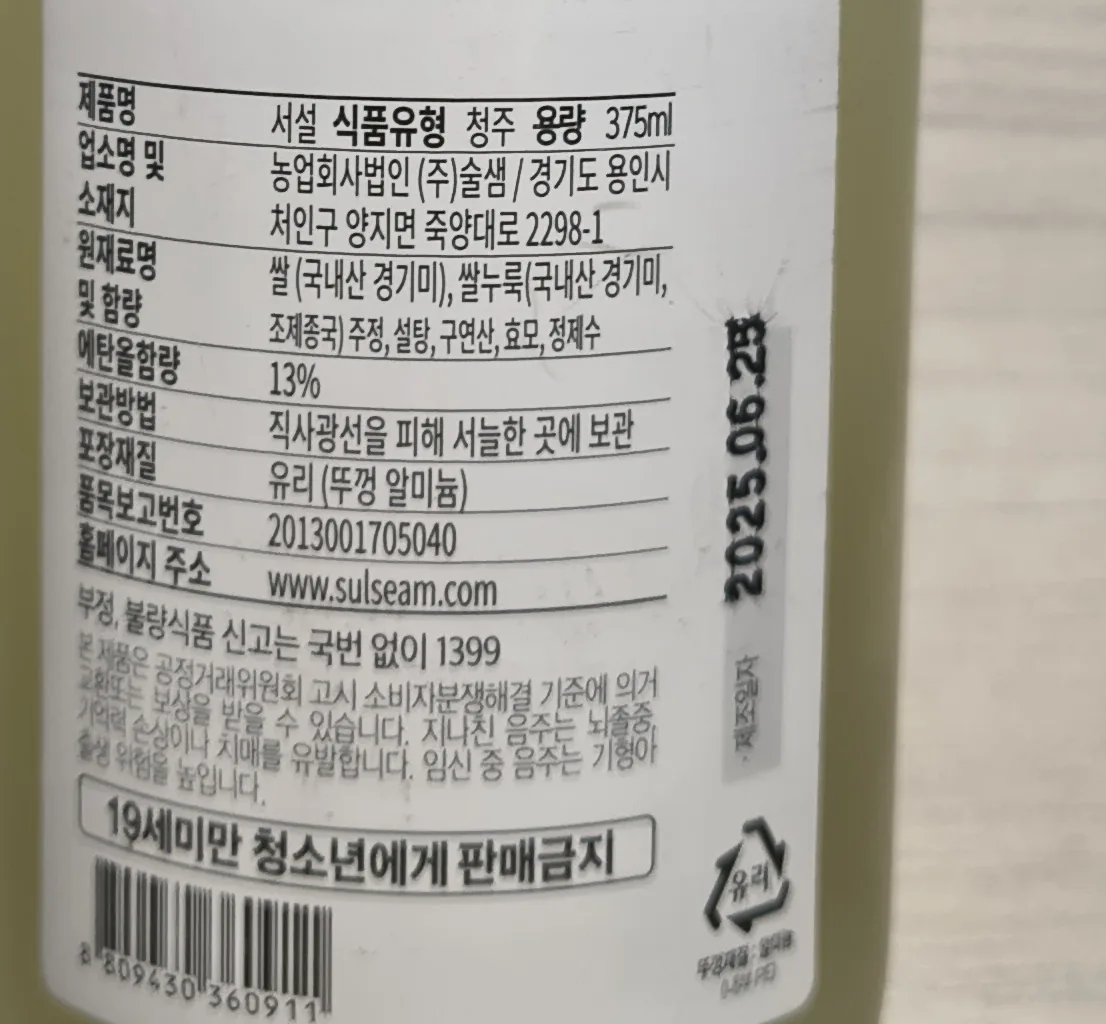
The back label of Seoseol declares a 375 ml cheongju at 13% ABV, made by Sulsaem in Yongin. The ingredients are Gyeonggi rice, rice nuruk made with selected spores, ethyl alcohol, sugar, citric acid, yeast and purified water. Added alcohol, sugar and acids are also allowed in Japanese sake, within legal limits.
| Korean line | What it says |
|---|---|
| 제품명 · 식품유형 · 용량 | Product name: Seoseol. Food type: cheongju. Contents: 375 ml |
| 업소명 및 소재지 | Producer and address: Sulsaem, an agricultural corporation, Yangji-myeon, Cheoin District, Yongin, Gyeonggi Province |
| 원재료명 및 함량 | Ingredients: Korean rice from Gyeonggi; rice nuruk (Gyeonggi rice, selected spores); ethyl alcohol; sugar; citric acid; yeast; purified water |
| 에탄올함량 | Alcohol content: 13% |
| 보관방법 | Storage: in a cool place, away from direct sunlight |
| 포장재질 | Packaging: glass, aluminum cap |
| 품목보고번호 | The number under which the product is registered with the food authority |
| 19세미만 청소년에게 판매금지 | Sale to anyone under 19 is prohibited |
The most surprising line is the ingredient list. If you picture a rice wine made only of rice, water and a starter, you find three additions instead: 주정, ethyl alcohol of agricultural origin; 설탕, sugar; 구연산, citric acid. They are not a Korean oddity. Japanese law defines sake (legally, seishu) as a fermented drink of rice, koji and water under 22% ABV, and allows alcohol, sugars and acidifiers as additional ingredients, as long as together they stay under half the weight of the rice and koji. Sake made with no additions exists and is a category of its own.
What the label does not give is quantities. We do not know how much alcohol was added or how many grams of sugar there are per liter, so you cannot tell how sweet Seoseol is by reading the bottle. Below the table there is also the health warning required in Korea: excessive drinking causes stroke, memory damage and dementia, and drinking during pregnancy raises the risk of birth defects.
Who makes Seoseol?
Sulsaem (술샘) is an agricultural company in Yongin, Gyeonggi Province, founded in 2012 by five graduates of the instructor course at the Korea Homebrew Institute (한국가양주연구소). It makes rice wines and spirits from rice grown in the province, and in 2018 its Mir 40 soju won the presidential award at Korea’s national traditional liquor competition.
Founding dates vary a little by source: the company was formed in 2012, registered as a business in 2013, and moved to Yongin in 2015. Its chief executive is Shin In-geon (신인건). In 2017 the Korean Ministry of Agriculture added it to “찾아가는 양조장”, its list of breweries open to visitors.
Besides Seoseol, the range includes Mir, a distilled soju at three strengths (25, 40 and 54% ABV), and Ihwaju, a makgeolli so thick it is eaten with a spoon. In the Korean press, Seoseol is presented as the brewery’s signature product.
What does it taste like and what does it go with?
The brewery describes Seoseol as having a fruity, apple-like aroma, which it credits to a native Korean yeast, and ferments and ages it at low temperature. The Korean press calls it dry and clean, and pairs it with raw white fish, Alaska pollock pancakes and clear fish soups.
These are third-party descriptions, and we report them as such: the apple aroma is what the brewery states and retailers repeat. Low-temperature fermentation is the same choice sake brewers make to get more aromatic, cleaner wines, at the cost of time.
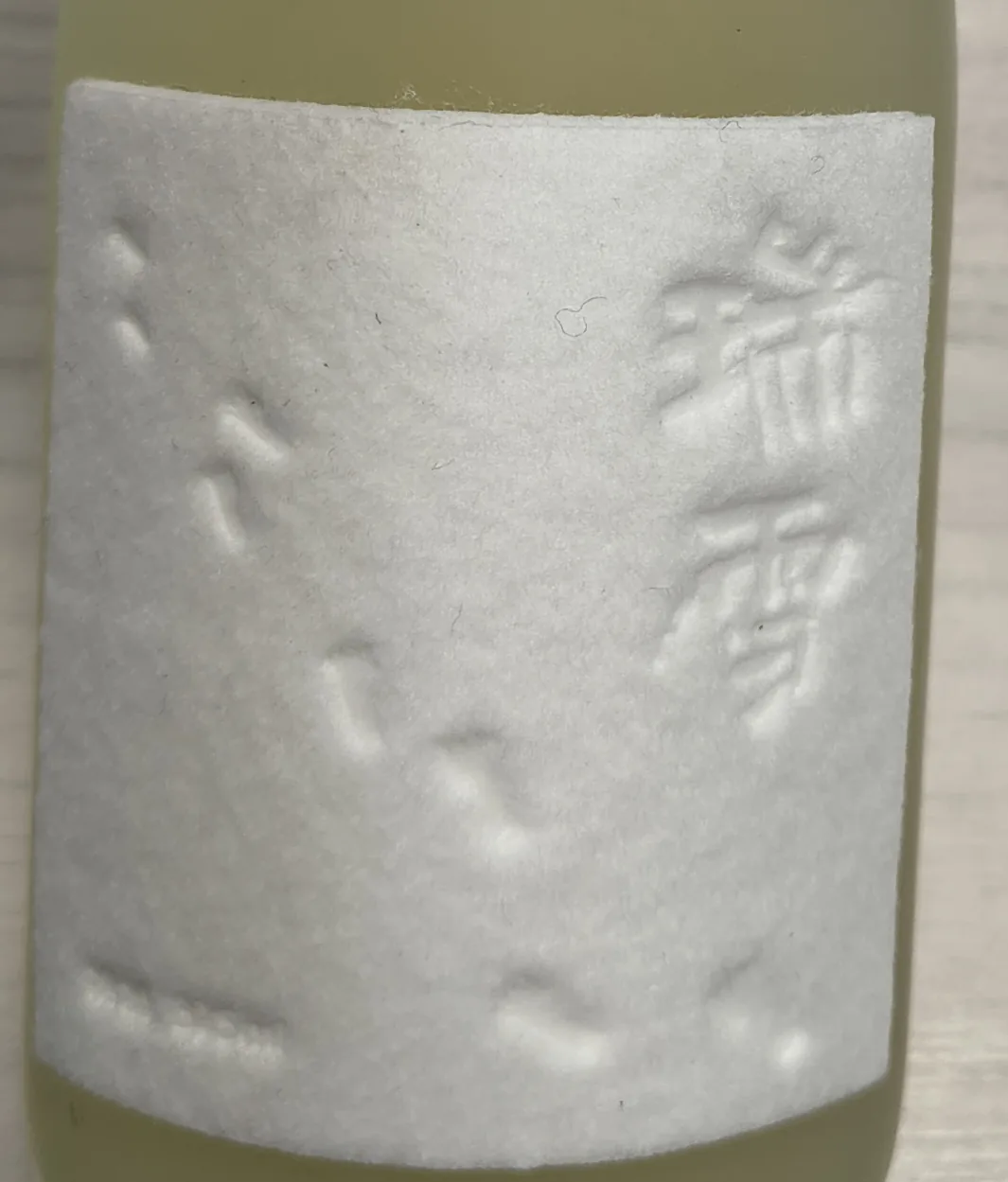
The name is part of the product too. 瑞雪 means “auspicious snow”, and the front label is a plain rectangle of white felt, with no color, just the two characters and a line of raised prints, like footsteps in snow.
How much alcohol and how many calories are in a bottle of Seoseol?
A 375 ml (12.7 fl oz) bottle of Seoseol at 13% ABV holds about 38 grams of alcohol, or about 2.7 US standard drinks of 14 grams. The alcohol alone is worth about 72 calories per 100 ml and 269 per bottle. The added sugar pushes the total higher, but the label does not say by how much.
| 5 fl oz glass (148 ml) | 375 ml bottle | 720 ml bottle | |
|---|---|---|---|
| Pure alcohol | 15.2 g | 38.5 g | 73.8 g |
| US standard drinks (14 g) | 1.1 | 2.7 | 5.3 |
| Calories from alcohol alone | 106 | 269 | 517 |
Grams of alcohol come from multiplying volume by ABV and by the density of alcohol, 0.789: for the small bottle, 375 × 0.13 × 0.789 gives 38.5 grams. Calories use the same formula as our page on calories in homemade limoncello and liqueurs, 5.52 calories per degree of ABV per 100 ml. The figures in the table are a floor, because the undeclared sugar adds calories that cannot be calculated.
For comparison, 100 ml of homemade limoncello at 30% ABV with 250 grams of sugar per liter comes to about 266 calories, more than three times as much. Seoseol has the strength of a table wine and is drunk in the same amounts: that is the right comparison, not a small after-dinner glass.
Frequently asked questions
Is cheongju the same as sake? Under Korean law, almost: cheongju means a clear rice wine made with koji, like sake. The differences are origin, since sake is Japanese, and name, since the clear Korean wine made with traditional nuruk is legally called yakju.
Is Seoseol a liqueur? No. It is a fermented rice drink at 13% ABV, closer to a wine than to a liqueur: it is not distilled and it is not a sweetened infusion, even though the label lists added alcohol and sugar.
What is the difference between cheongju and makgeolli? Makgeolli is cloudy because it keeps the rice particles from fermentation in suspension. Cheongju is the clear part of the same kind of ferment, separated from the sediment and filtered.
What does Seoseol mean? Seoseol is written 瑞雪 in Chinese characters and means “auspicious snow”. The front label shows it with a line of raised prints, like footsteps in snow.
How old do you have to be to buy it? In Korea, 19, as the label says. In the United States the minimum legal drinking age is 21.
How should Seoseol be stored? The label asks for a cool place away from direct sunlight. It gives no instructions for an open bottle, so treat it like a white wine: recorked and in the fridge.
This article describes a commercial product and contains no affiliate links: liquori.it has no relationship with the producer. Tasting notes are those published by the brewery and the Korean press. Drink responsibly, and never before driving.