Sarti Rosa came out in Germany in the summer of 2022, reached Italy in 2025 and arrived in the United States in 2026, where Campari calls it the largest investment it has ever made behind an aperitivo launch. On a site about homemade liqueurs it is a commercial product, like the profile of Biancosarti, which comes from the same house. Here you will find what the label says, why it stopped being a liqueur within a few years, how much alcohol a spritz holds and how many calories it has.
What is Sarti Rosa and who makes it?
Sarti Rosa is an aperitivo made from neutral spirit, sugar and fruit juices, produced by Davide Campari-Milano. The Sarti name comes from the distillery Luigi Sarti founded in Bologna in 1885, best known for Biancosarti, and it joined Campari Group in 1995. Sarti Rosa itself was created in 2022.
The Sarti distillery made spirits and liqueurs in Bologna, in northern Italy, from the late 1800s. Its best-known product is Biancosarti, a white bitter at 28% ABV. The brand came to Campari in 1995, when the Milan group bought the Italian business of the Dutch company Bols Wessanen; Crodino and Cynar were part of the same deal. Some retailer listings date the acquisition to the 1970s, but the group history published by Campari’s corporate museum gives 1995.
Sarti Rosa takes its name from the old catalog. It is a new product, built for the spritz, and it rolled out in stages:
| When | Where | What |
|---|---|---|
| Summer 2022 | Germany | First launch, at 17% ABV and sold as a liqueur |
| February 2025 | United Kingdom | Reaches supermarkets and bar chains |
| June 2025 | Italy | Reaches the Italian market after the run abroad |
| June 2026 | United States | Rollout to stores and bars, with the official launch on September 8, 2026 |
What is the ABV of Sarti Rosa, and why is it no longer a liqueur?
Sarti Rosa sold today is 14% ABV, or 28 proof. At launch in 2022 it was 17% and sold as a liqueur. Under European Union rules a liqueur must be at least 15% ABV, so at 14% Sarti Rosa lost that name, and its label now calls it an aperitivo.
The change went almost unnoticed. The first German reviews, from July 2022, describe a 17% liqueur; the same outlet later updated its page, noting the strength had dropped to 14% and the legal name had changed from “Likör” to “alcoholic beverage.” Some online shops still mix up the two versions, so if you see 17% listed, that is the launch recipe.
The 15% threshold comes from EU Regulation 2019/787, which also sets a minimum of 100 grams of sugar per liter for liqueurs. Sarti Rosa has more than twice that much sugar, but one degree too little alcohol. “Aperitivo,” on the other hand, is a trade name anyone can use: Aperol, at 11% ABV, goes by it too.
What is in the bottle?
According to the European label of the 14% version, Sarti Rosa contains water, sugar, vodka, citric acid, flavorings, orange, passion fruit and mango juices, and two colorings: E122 and E129. Per 100 ml (3.4 fl oz) it declares 160 kcal, 23 grams of carbohydrates of which 22 are sugars, and no fat or protein.
| Label item | Value |
|---|---|
| ABV | 14% (28 proof) |
| Size | 700 ml in Europe |
| Ingredients | Water, sugar, vodka, acidulant (citric acid), flavorings, orange juice, passion fruit juice, mango juice, colorings E122 and E129 |
| Energy per 100 ml | 660 kJ, 160 kcal |
| Carbohydrates per 100 ml | 23 g, of which sugars 22 g |
| Fat, protein, salt | 0 g |
| Producer | Davide Campari-Milano, plant in Canale, Piedmont, Italy |
The data come from the label as reported by an international duty-free retailer, and two German retailers list the same colorings. The pink comes from two synthetic food dyes: E122, carmoisine, and E129, Allura Red, known in the US as FD&C Red 40. Some American listings mention “natural colorings,” while the European bottle lists these two. Formulas can differ between markets, so the label on the bottle you buy is the one to trust.
A note on calories. With the formula we use for calories in homemade limoncello and liqueurs, 5.52 kcal per degree of alcohol plus 4 kcal per gram of sugar, you get about 165 kcal per 100 ml: 77 from alcohol and 88 from sugar. The label says 160, and the gap is within the rounding allowed on nutrition labels.
How do you make a Sarti Spritz?
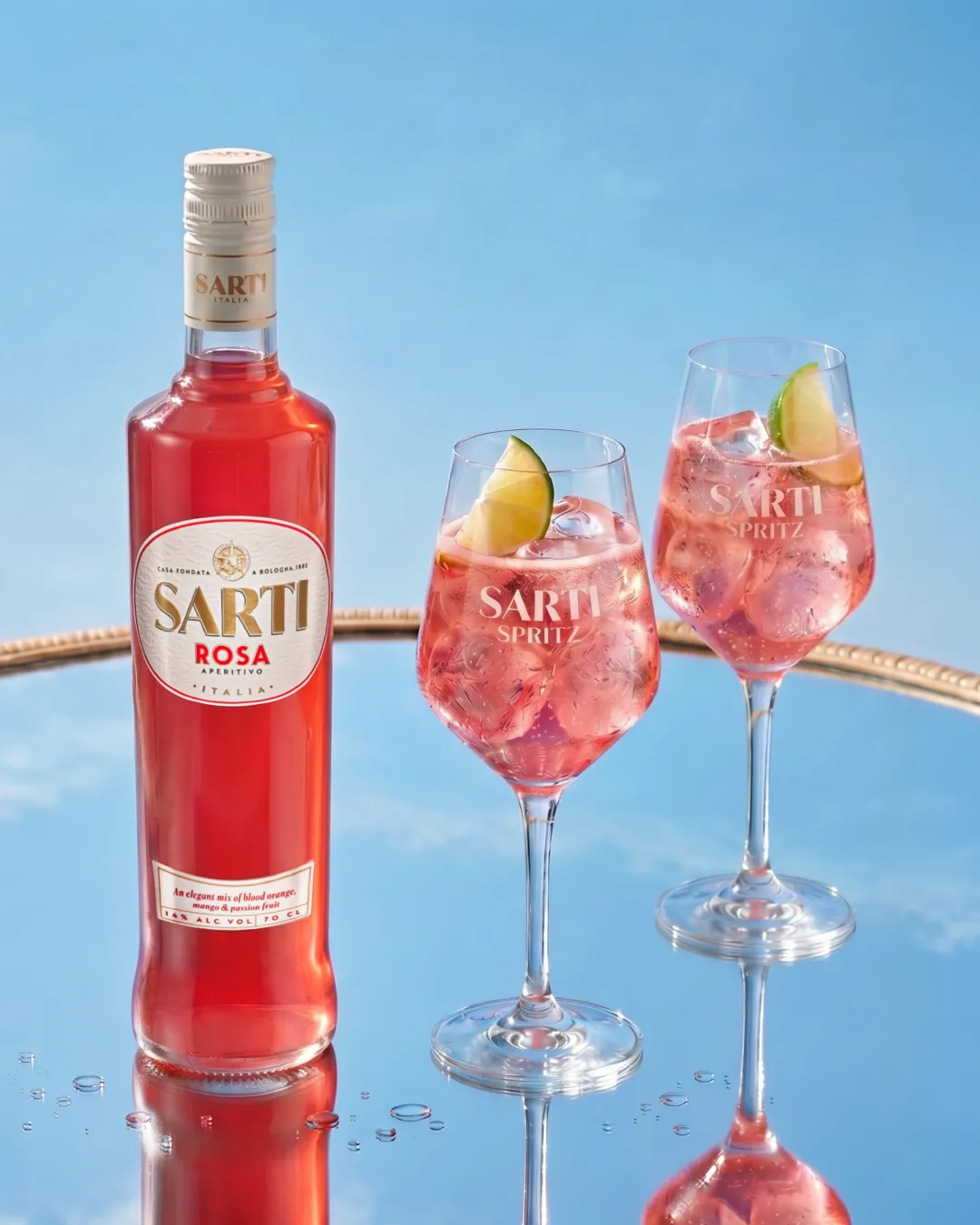
The official Sarti Spritz is built in a large wine glass filled with ice: 3 parts Prosecco DOC, 2 parts Sarti Rosa and a slice of fresh lime. The European version adds a splash of soda; Campari UK gives it as 75 ml (2.5 fl oz) of Prosecco, 50 ml (1.7 fl oz) of Sarti Rosa and 25 ml (0.85 fl oz) of soda.
- Fill a large wine glass with ice.
- Pour the Prosecco, then the Sarti Rosa.
- Top with a splash of soda if you like it lighter, and stir gently so you keep the bubbles.
- Garnish with a slice of lime.
The proportions are the same as an Aperol Spritz, because Campari sells Sarti Rosa as the fruitier, sweeter alternative to its most famous spritz. The garnish changes, with lime in place of the orange slice. For a party:
| Spritzes | Prosecco | Sarti Rosa | Soda |
|---|---|---|---|
| 1 | 75 ml (2.5 fl oz) | 50 ml (1.7 fl oz) | 25 ml (0.85 fl oz) |
| 4 | 300 ml (10 fl oz) | 200 ml (6.8 fl oz) | 100 ml (3.4 fl oz) |
| 6 | 450 ml (15 fl oz) | 300 ml (10 fl oz) | 150 ml (5 fl oz) |
| 10 | 750 ml (one bottle) | 500 ml (17 fl oz) | 250 ml (8.5 fl oz) |
A 700 ml bottle of Sarti Rosa makes 14 spritzes; a 750 ml bottle of Prosecco makes 10.
How much alcohol and how many calories are in a Sarti Spritz?
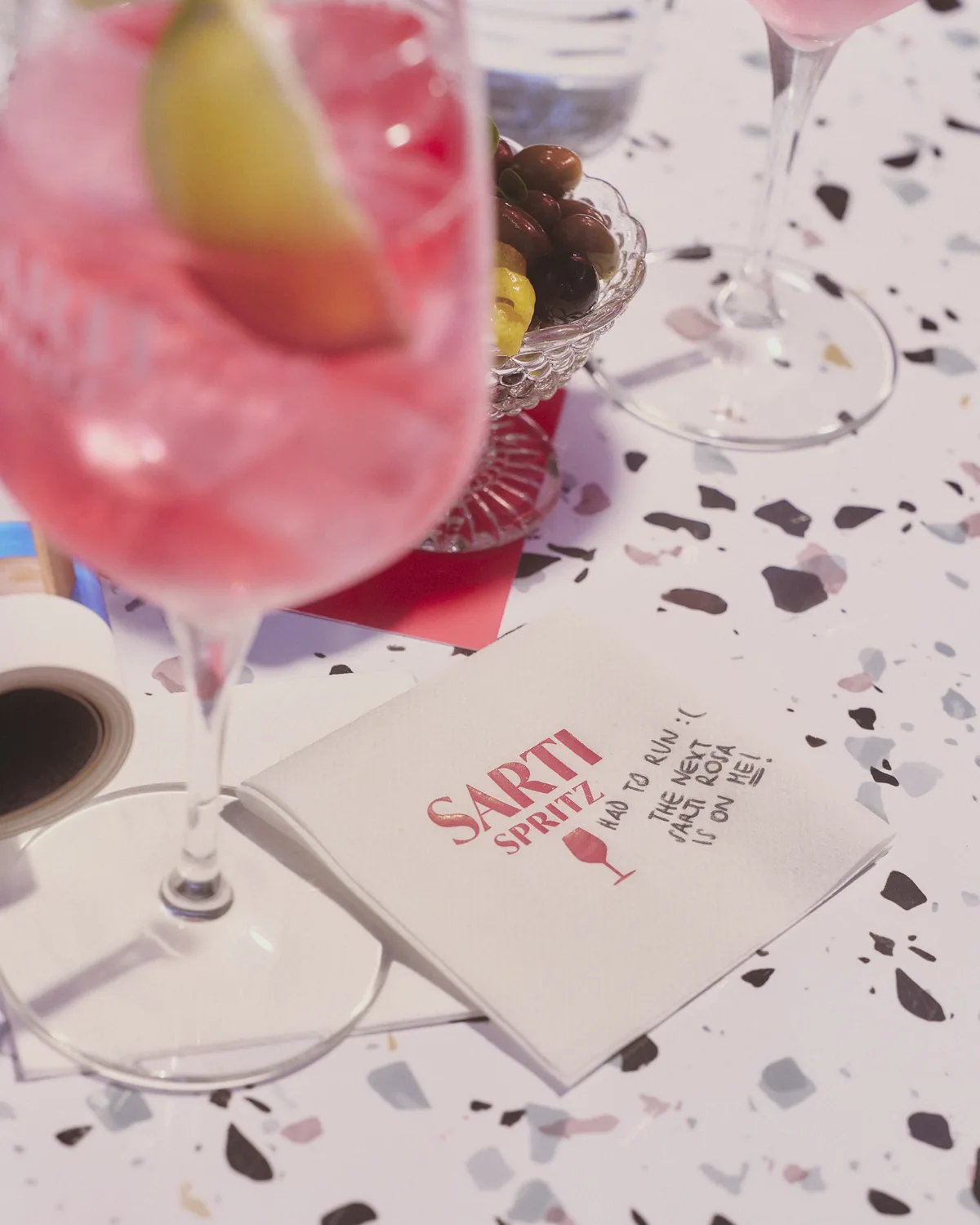
A 150 ml (5 fl oz) Sarti Spritz made with 11% Prosecco contains about 12 grams of alcohol, a little less than one US standard drink of 14 grams, and is around 10% ABV before the ice dilutes it. It has about 130 calories: 80 from the Sarti Rosa, the rest from the Prosecco.
| Ingredient | Amount | Alcohol | Sugar | kcal |
|---|---|---|---|---|
| Sarti Rosa (14%) | 50 ml (1.7 fl oz) | 5.5 g | 11 g | 80 |
| Prosecco extra dry (11%) | 75 ml (2.5 fl oz) | 6.5 g | about 1 g | about 50 |
| Soda | 25 ml (0.85 fl oz) | 0 | 0 | 0 |
| Sarti Spritz | 150 ml (5 fl oz) | 12 g | about 12 g | about 130 |
The math: grams of alcohol are volume times ABV times 0.789, the density of ethanol. For Sarti Rosa the calories are the label’s (160 per 100 ml, so 80 per 50 ml); for the Prosecco we calculated them with the site’s formula, assuming 11% ABV and 15 grams of sugar per liter, a typical value for extra dry. With a brut the sugar drops below one gram and the calories barely change, because in Prosecco most of them come from the alcohol.
The same spritz made with Aperol, which is 11% ABV instead of 14%, contains about 11 grams of alcohol. The difference is one gram per glass. The sugar matters more: 11 grams in 1.7 fl oz of Sarti Rosa is more than two teaspoons.
What is the difference between Sarti Rosa, Aperol and Biancosarti?
They are three Campari Group aperitivi with different uses. Sarti Rosa is 14% ABV, sweet and fruity; Aperol is 11% ABV, with an orange profile and a bitter finish; Biancosarti is 28% ABV and a dry bitter. The first two are made for the spritz, the third mostly for mixing.
| Sarti Rosa | Aperol | Biancosarti | |
|---|---|---|---|
| ABV | 14% | 11% | 28% |
| Color | Pink | Orange | Deep yellow |
| Profile | Sweet, fruity | Citrusy, bittersweet | Bitter, dry |
| Main flavors | Blood orange, passion fruit, mango | Orange, bitter herbs and roots | Gentian, cinchona, bitter orange |
| Typical use | Spritz | Spritz | Cocktails, chilled neat |
Sarti Rosa is the least bitter of the three, and Campari says so openly: it aims it at a slightly younger crowd than Aperol’s, looking for a sweeter spritz. If you like the bitter side of the Italian aperitivo, it will be far from your taste.
What does Sarti Rosa taste like?
The producer describes Sarti Rosa as fruity and sweet, with blood orange, passion fruit and mango. At 220 grams of sugar per liter it is almost as sweet as a homemade limoncello, which has around 250, but with half the alcohol.
The comparison with limoncello helps place it: similar sugar, much less alcohol, so chilled and neat it comes across as syrupy rather than warm. Its place is in the spritz or lengthened with soda, which Campari suggests as a Sarti Soda.
Frequently asked questions about Sarti Rosa
What is the ABV of Sarti Rosa? Sarti Rosa sold today is 14% ABV, or 28 proof. At launch in Germany in 2022 it was 17% and sold as a liqueur; dropping below 15% it lost that legal name in the European Union.
Who makes Sarti Rosa? Davide Campari-Milano. The Sarti name comes from the distillery founded in Bologna in 1885, the house of Biancosarti, which joined Campari Group in 1995.
What is the Sarti Spritz recipe? In a large wine glass filled with ice: 3 parts Prosecco DOC, 2 parts Sarti Rosa and a slice of lime, with an optional splash of soda. In milliliters: 75 of Prosecco, 50 of Sarti Rosa and 25 of soda.
Is Sarti Rosa bitter? No, it is the least bitter of Campari Group’s aperitivi. It is sweet and fruity, with 22 grams of sugars per 100 ml, and its acidity comes from citric acid and citrus.
How many calories are in Sarti Rosa? The European label declares 160 kcal per 100 ml, so 80 kcal in the 1.7 fl oz of a spritz. The whole spritz, with the Prosecco, comes to about 130 kcal.
Where does the pink color of Sarti Rosa come from? From the colorings E122 and E129 listed on the European label, that is carmoisine and Allura Red. The orange, passion fruit and mango juices are there for the flavor.
This article describes a commercial product and contains no affiliate links: liquori.it has no relationship with the producer. Tasting notes are those published by the producer. You must be 21 or older to buy alcohol in the United States. Drink responsibly, and never before driving. Cover photo: Campari Group.