Diatomaceous earth, also called DE, kieselguhr or diatomite, is the material many wineries and breweries use to filter wine and beer. In homemade liqueur it solves one specific problem: filter paper that clogs after a few glasses, as it does with pulpy fruit liqueurs, with nocino or with an infusion full of herb fragments. The layer of earth catches the fine particles in place of the paper, and the liqueur keeps flowing.
This guide gives the winemaking doses scaled down to a kitchen funnel, the procedure step by step, what US and European rules say and how to handle the dust. For the simpler methods, cheesecloth, paper and plate filters, see the guide on how to filter homemade liqueur.
What is diatomaceous earth and why does it filter better than paper?
Diatomaceous earth is a powder made of the silica skeletons of microscopic algae, diatoms, laid down on the beds of ancient lakes and seas. The grains are porous and irregular: stacked on filter paper they form a layer a few millimeters thick, full of tiny channels, that holds back fine particles while the liquid passes through.
Filter paper works at its surface. Particles stop on the paper, close its pores, and the flow slows almost to a halt: with a fruit liqueur that happens after a few deciliters. A layer of diatomaceous earth works in depth: particles lodge inside the thickness of the grains, and the surface of the filter stays open longer.
Diatomaceous earth is insoluble, so it all stays on the paper: winemaking product data sheets state this too. Only the filtered liqueur reaches the glass.
Which diatomaceous earth do you use for liqueur?
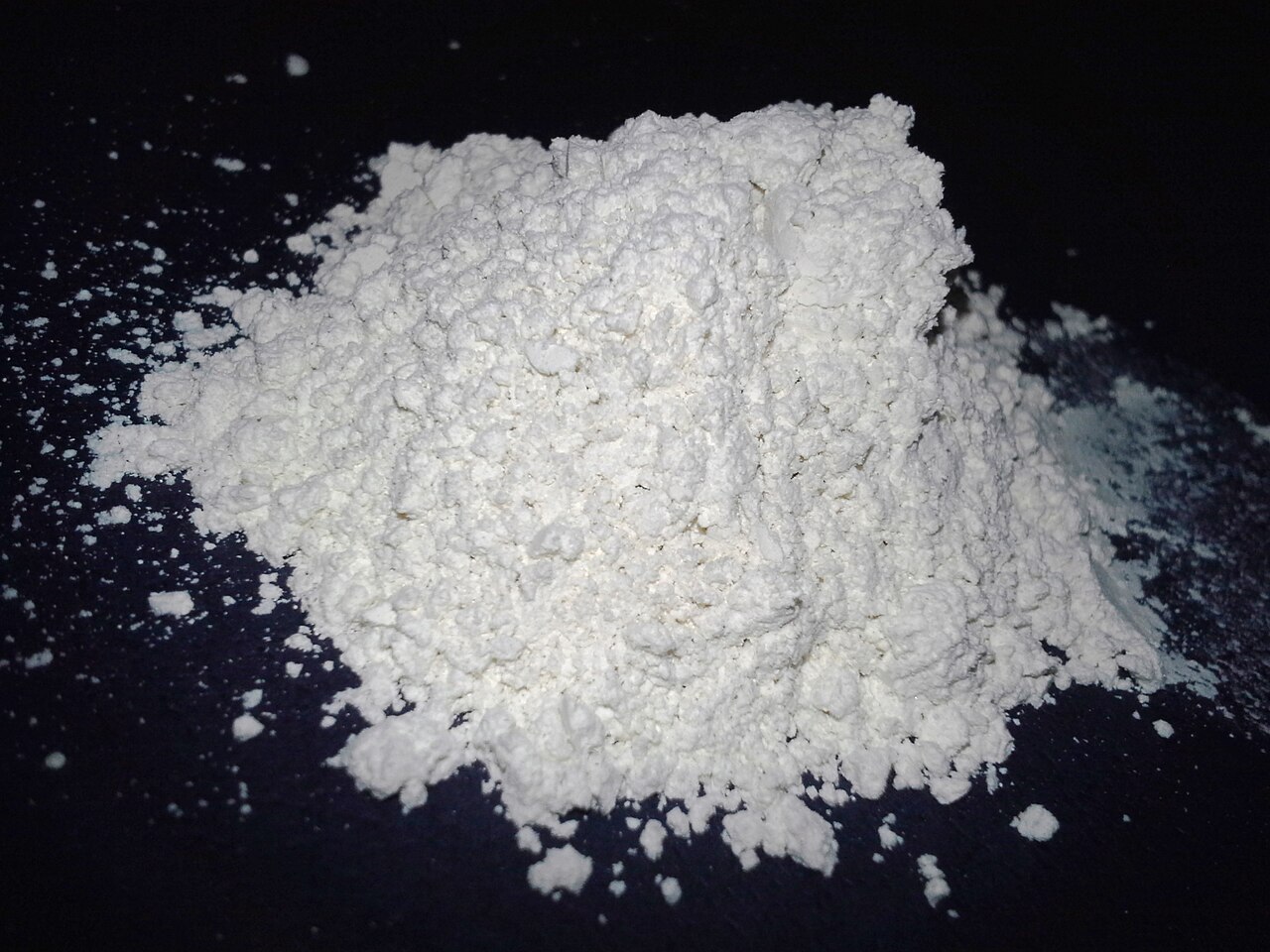
Use only diatomaceous earth sold for filtering wine or beer, with its technical data sheet. Pink grades are the finest and are used for final polishing; white grades are coarser and suit very cloudy liquids. Garden, insect-control and pool-filter DE are different products made for other uses.
Winemaking grades differ in permeability, meaning how fast they let liquid through. The data sheet for the Enolite line by Enartis, an Italian maker of winemaking products, shows the range: the pink grades have a permeability of 0.03 to 0.2 darcy and are meant for “fine particle suspensions”; the white grades reach 5 to 8 darcy and are meant for lees and very cloudy liquids. Pink grades are calcined, that is fired at high temperature; white grades are flux-calcined, fired with an added flux.
| Liqueur | Suitable grade | Why |
|---|---|---|
| Fruit liqueur with pulp, persimmon or fig liqueur | Coarse (white) | Lots of particles: a fine grade clogs just like paper |
| Nocino, amari, herb infusions with fragments | Medium | Particles of many sizes and a dark sediment that forms over the months |
| Liqueur already passed through cheesecloth and paper, with a remaining haze | Fine (pink) | Only the smallest particles are left |
Garden DE and pool-filter DE are easy to find in hardware stores, often for less. They have a different purpose and a different safety data sheet. Only winemaking grades state purity guarantees on metals and microbes. For liqueur, buy DE from a winemaking or homebrewing supply store.
How much diatomaceous earth do you need to filter liqueur?
The layer on the paper takes 300 to 500 grams per square meter of filter, that is 3.5 to 5.5 grams (about 0.12 to 0.19 oz) for a flat 12 cm (4.7 in) funnel. For a very cloudy liqueur, add 0.5 to 1.5 grams per liter stirred into the liqueur. These are winemaking doses scaled to the surface of a kitchen funnel.
Wineries use diatomaceous earth in two ways, and both work at home. The first is the precoat: a layer of earth spread on the filter before you start. The second is body feed: earth mixed into the liquid being filtered, which settles on the precoat as the liquid flows and keeps it open.
The precoat dose depends on the filter surface, not on how much liqueur you have. The Enolite data sheet gives 300 to 500 grams per square meter. For body feed the same sheet gives 40 to 80 grams per hectoliter for nearly clear liquids and 150 grams per hectoliter for very cloudy ones, that is 0.4 to 1.5 grams per liter.
| Flat filter diameter | Surface | Earth for the precoat |
|---|---|---|
| 9 cm (3.5 in) | 64 cm² (9.9 sq in) | 2 to 3 g |
| 12 cm (4.7 in) | 113 cm² (17.5 sq in) | 3.5 to 5.5 g |
| 15 cm (6 in) | 177 cm² (27.4 sq in) | 5.5 to 9 g |
The math: filter surface in square meters times 300 and times 500. A 12 cm circle measures 0.0113 square meters, which gives 3.4 and 5.7 grams, rounded to 3.5 and 5.5. With a cone funnel the paper is larger than the circle of the mouth, but the layer settles mostly at the bottom: start from the lower dose and go up only if the first liquid runs cloudy for a long time.
These doses come from wine. No published doses exist for homemade liqueur, and a fruit liqueur can carry more solids than a cloudy wine: that is why the first time you try it on one glass.
How do you filter liqueur with diatomaceous earth, step by step?
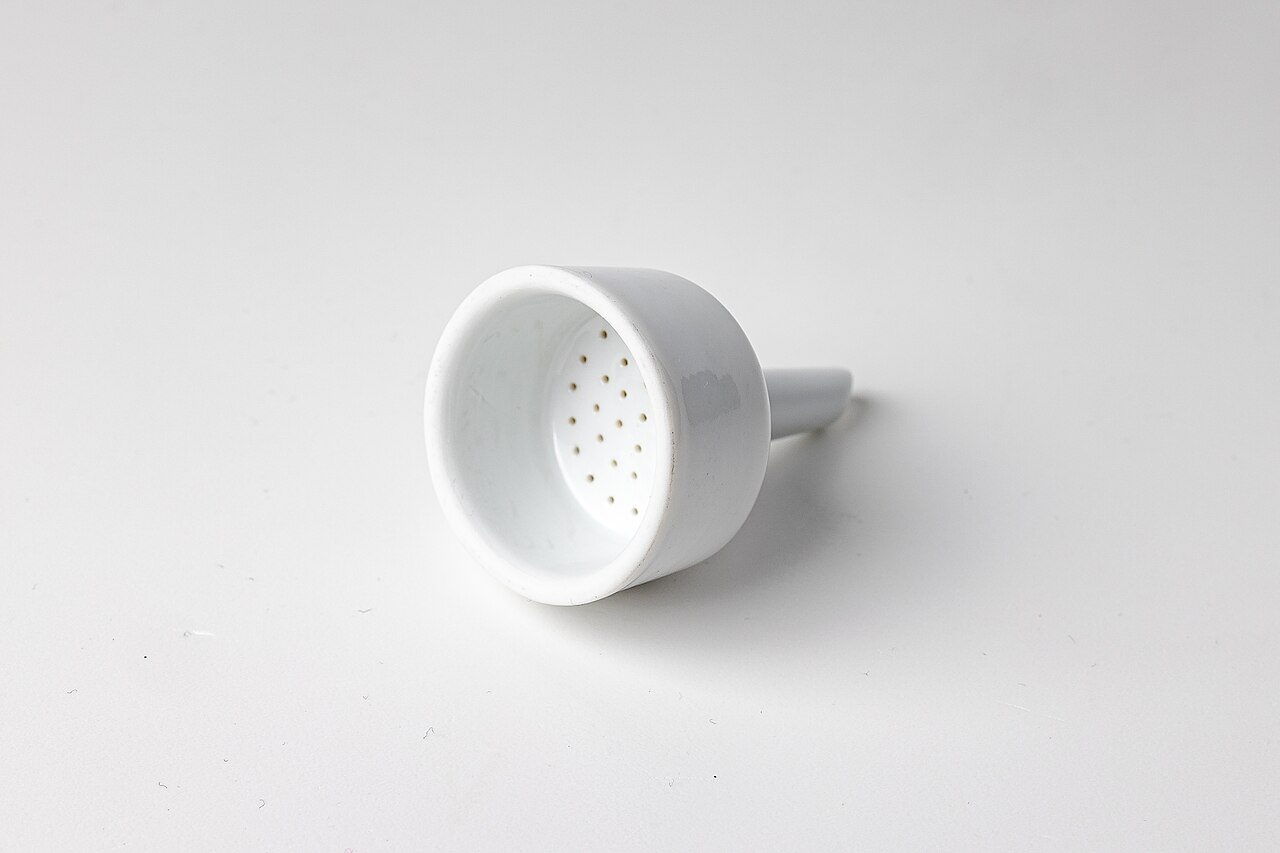
Weigh the earth wearing a mask, stir it into a little of the same liqueur and pour it onto the filter paper to form the layer. Pour the first cloudy liquid back on top, then pour the rest of the liqueur slowly, without breaking the layer. When you finish, throw the layer away while it is still wet.
- Prepare the liqueur. Pass it through cheesecloth or a strainer first to remove peels, pulp and large fragments: diatomaceous earth is for fine particles, while large pieces would clog it at once.
- Weigh the earth wearing a mask. Use a particulate respirator rated N95 or better (FFP3 in Europe), weigh in a spot without drafts and pour the powder gently, without dropping it from a height.
- Set up the funnel. A Büchner funnel, with its flat perforated bottom, works well, and so does a regular funnel with filter paper. Wet the paper with a splash of liqueur so it sticks to the sides.
- Form the precoat. Stir the earth into about 100 ml (3.4 fl oz) of the same liqueur and pour the slurry onto the paper. The earth settles into an even layer.
- Pour the first liquid back on top. The liqueur that comes out at first has a white haze, because the layer is still settling. Collect it and pour it back into the funnel until it runs clear.
- Filter the rest slowly. Pour the liqueur down the side of the funnel, without aiming at the layer. If the liqueur is very cloudy, stir 0.5 to 1.5 grams of earth per liter into it before pouring, and stir again now and then.
- Throw away the wet layer. At the end the earth is full of what it caught. Discard it still damp, together with the paper, so it makes no dust.
The layer of earth stays soaked with liqueur, like any filter: the more earth you use, the more liqueur you lose. That is one more reason to start from the lower dose.
When is diatomaceous earth worth it, and when is paper enough?
Diatomaceous earth is worth it when paper clogs: fruit liqueurs with pulp, nocino, amari with lots of herbs, batches of several liters. For limoncello or a liqueur that is already nearly clear, cheesecloth and paper are enough, cost less and need no precautions for dust.
| Method | When to use it | Limit |
|---|---|---|
| Cheesecloth and filter paper | Limoncello, citrus liqueurs, infusions that are already nearly clear | Paper clogs with liquids full of particles |
| Diatomaceous earth on paper | Pulpy fruit liqueurs, nocino, amari, batches of several liters | Dust to handle with a mask, a test to run the first time |
| Plate filter | Frequent filtering of large amounts | Cost of the frame and the plates |
The milky haze of limoncello is a separate case. It is made of essential oil droplets about two tenths of a micron across, and they carry the aroma: the guide on bitter or cloudy limoncello explains where they come from. No published measurement says how much of it a fine grade of diatomaceous earth holds back. If the layer stopped those droplets, it would also stop part of the aroma: if you want to try, filter 200 ml (6.8 fl oz) first and compare it with the unfiltered liqueur.
Is it legal to filter liqueur with diatomaceous earth?
Yes. Making liqueur at home from store-bought alcohol for personal use is legal under US federal law, and no rule covers how you filter it. For commercial producers diatomaceous earth is a processing aid: it is used during production and stays on the filter. For wine, the US Alcohol and Tobacco Tax and Trade Bureau lists it among inert filtering aids.
Infusing alcohol you bought, for yourself and your household, is legal at the federal level; selling it requires licenses, and distilling at home requires a federal permit. The legal drinking age is 21. The way you filter is up to the person making the liqueur.
For producers, three references are useful:
- in the United States, the Alcohol and Tobacco Tax and Trade Bureau (TTB) names diatomaceous earth among the inert filtering aids that may be used in the cellar treatment of wine (27 CFR 24.243). A distilled spirits producer follows TTB and FDA rules for its own category and should confirm them with those agencies;
- in the European Union, Regulation (EC) 1333/2008 on food additives defines a processing aid as a substance used on purpose during processing for a technological reason, which may leave only technically unavoidable residues with no effect on the finished product. Diatomaceous earth that stays on the filter fits that definition;
- for wine in the EU, Delegated Regulation (EU) 2019/934 on winemaking practices allows filtration with or without an inert filtering aid, as long as it leaves no undesirable residues. It covers wine, but it is the closest technical reference for liqueur.
These notes describe the rules: a business that sells liqueur should check them with TTB, the FDA or a consultant.
Is diatomaceous earth dangerous?
The main risk is the dust you breathe. Calcined and flux-calcined grades contain cristobalite, a form of crystalline silica that the International Agency for Research on Cancer (IARC) classifies as carcinogenic when inhaled. That is why you weigh it wearing a particulate respirator and throw it away wet.
Natural diatomaceous earth, never fired, is mostly amorphous silica, which IARC places in group 3, the substances not classifiable. The firing that makes the earth better for filtering turns part of the silica into cristobalite, which IARC places in group 1 when inhaled as dust. The Oenological Codex of the OIV, the International Organisation of Vine and Wine, prescribes a protective mask for anyone using diatomite. The hazard is exposure to the dust, which is why the earth should be wet as soon as possible.
The second concern is metals. Diatomaceous earths contain traces of iron, arsenic, lead and cadmium. The same OIV monograph sets limits for winemaking grades: less than 300 mg/kg of iron, 5 of lead, 3 of arsenic and 1 of mercury. A US Food and Drug Administration study (Redan and colleagues, Journal of Agricultural and Food Chemistry, 2019) filtered beer and wine with 2 grams per liter of an earth containing 5.4 mg/kg of soluble arsenic: inorganic arsenic in the liquid rose by 11 to 14 micrograms per liter. The transfer dropped with less earth and with earth washed before use. That is why a winemaking grade, which states its limits, and the lowest dose that does the job are the better choice.
Common mistakes with diatomaceous earth
| Mistake | What happens |
|---|---|
| Using garden or pool-filter DE | You filter the liqueur with a product that has no food-grade purity guarantees |
| Pouring dry earth onto the paper | The layer comes out uneven and the dust rises; stir it into the liqueur first |
| Bottling the first liquid that comes out | It carries a haze of earth; pour it back on top until it runs clear |
| Pouring the liqueur straight onto the layer | The layer breaks and the earth passes through with the liqueur |
| Skipping the cheesecloth | Peels and pulp cover the layer and clog it at once |
| Weighing without a mask | You breathe the dust, which is the real risk of diatomaceous earth |
Frequently asked questions
Does diatomaceous earth stay in the liqueur? No, it is insoluble and stays on the paper. If the liqueur comes out with a white haze, the layer has broken or is still settling: pour the liqueur back into the funnel until it runs clear.
Can you use garden diatomaceous earth to filter liqueur? No. Liqueur needs diatomaceous earth sold for filtering wine or beer, with its data sheet: garden and pool-filter DE are made for other uses and carry no food-grade purity guarantees.
Does diatomaceous earth remove the haze from limoncello? No published measurement says so. The haze is made of essential oil droplets that carry the aroma, so if you want to try, filter 200 ml first and compare it with the unfiltered liqueur.
Can you reuse the layer of diatomaceous earth? No. At the end of filtering it is full of the particles it caught: throw it away while still wet, together with the paper, and prepare a new one for the next batch.
Where do you buy diatomaceous earth for filtering liqueur? At winemaking and homebrewing supply stores, where it is sold for filtering wine and beer. Choose a package with a data sheet that states the grade and the limits on metals.
Making liqueur at home for personal use is legal; selling it requires licenses. Handle diatomaceous earth with a mask and keep it out of reach of children, like any fine powder.